
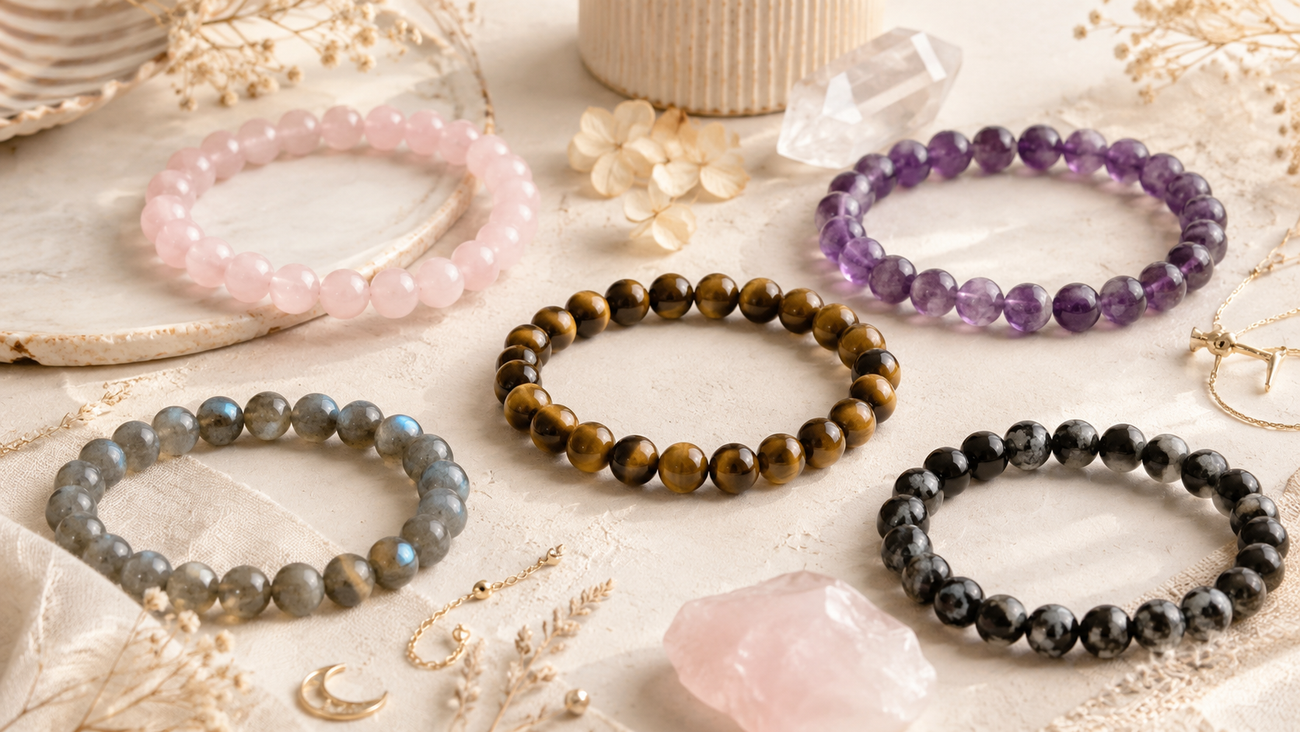
Thinking about treating yourself to a natural stone bracelet but not sure where to start? The options feel endless: bead size, material, colour, spiritual intention... This decision isn't trivial, and for good reason: a natural stone bracelet shouldn't be chosen at random.
This complete guide walks you through every step to find the crystal healing bracelet that's truly right for you. Whether you're after a piece for protection, love, confidence, or simply energetic balance, you'll know exactly how to go about it.
1. Measuring your wrist: the essential first step
Before anything else, you need to know your wrist size. A poorly fitted bracelet is a piece of jewelry you won't wear. Here's how to measure correctly.
How to measure correctly
Take a soft tape measure (or a piece of string you'll measure afterward) and wrap it around your wrist. Measure at the exact spot where you'll wear the bracelet — usually just above the wrist bone, at its narrowest point.
For the best accuracy:
- Measure your wrist in the morning (wrists swell slightly over the day)
- The tape should sit snugly but not tight
- Note the measurement in centimetres
- Measure both wrists if you're ambidextrous — they're not always identical
How much ease to add depending on style
Once you've measured your wrist, you need to add some ease. How much depends on the style you prefer:
- Slim fit: +0.5 cm. For a clean, modern look.
- Comfortable (standard): +1 to 1.5 cm. The classic choice.
- Loose fit: +2 to 2.5 cm. A more relaxed, bohemian style.
Most Brillanceleste bracelets offer this flexibility thanks to quality stretch elastic that adapts to your comfort.
2. Choosing bead size: understanding the visual difference
Bead size isn't just an aesthetic question. It affects the bracelet's look, weight, and even how comfortable it is to wear daily.
6 mm vs 8 mm vs 10 mm beads: what's the difference?
6 mm beads: The most delicate and understated size. Ideal if you prefer subtlety or like to stack several bracelets together.
8 mm beads: The aesthetic and practical "sweet spot." Also the most versatile size in crystal healing.
10 mm beads: For a bolder bracelet. Generally best reserved for wrists over 18 cm.
Fine or wide beads depending on your wrist
- Small wrist (under 16 cm): 6 mm or 8 mm for proportional harmony
- Medium wrist (16–18 cm): 8 mm is ideal, 6 mm or 10 mm depending on preference
- Large wrist (over 18 cm): 10 mm for visual impact, 8 mm for subtlety
3. Choosing your stone based on your intention
This is the heart of the bracelet: which natural stone matches your needs? In crystal healing, each stone carries specific properties tied to an intention.
Stones for protection
Tiger's eye: The protective stone par excellence. It's said to repel negative energy and boost personal confidence.
Black obsidian: A powerful stone for energetic protection. It's said to create a shield against negative influences.
Black tourmaline: The queen of energetic protection. Said to neutralize negative energy and stabilize the aura.
Stones for love and gentleness
Rose quartz: The stone of unconditional love, tenderness, and calm. Linked to the heart chakra.
Green aventurine: A stone of the heart and harmony. Said to encourage personal growth and hope.
Rhodonite: The stone of active love and forgiveness.
Stones for energy and confidence
Citrine: The stone of radiance and positivity. Said to bring energy and mental clarity.
Carnelian: The stone of action and vitality. Said to boost self-confidence and courage.
Amethyst: Beyond spirituality, amethyst is said to calm and clarify the mind.
Choosing based on your chakras
In crystal healing, chakras play a central role. These are seven energy centres running along the body, each linked to a colour, a function, and specific stones. Wearing a natural stone bracelet on the wrist lets you continuously work on one or more of these centres throughout the day.
Root chakra (red/black): Located at the base of the spine, it governs grounding, security, and connection to the physical body. Garnet, black tourmaline, and hematite are associated with it. A bracelet in these stones suits people going through a period of instability or needing to reconnect with the present moment.
Sacral chakra (orange): Located below the navel, it's linked to creativity, pleasure, and vitality. Carnelian and orange calcite are the stones of choice. They particularly suit people seeking inspiration or going through a creative block.
Solar plexus (yellow): This centre, located at the stomach, governs self-confidence and self-assertion. Citrine and amber are associated with it: recommended for regaining confidence before a speech, an interview, or an important decision.
Heart chakra (green/pink): At the centre of the chest, it concerns love, compassion, and relational harmony. Rose quartz and green aventurine are its emblematic stones, ideal for soothing a wounded heart or nurturing an existing relationship.
Throat chakra (blue): It governs expression and communication. Blue apatite and chalcedony are recommended for those who struggle to express their emotions or needs, or who want to gain ease speaking aloud.
Third eye chakra (indigo): Located between the eyebrows, it's linked to intuition and mental clarity. Amethyst and lapis lazuli are tied to it, often chosen by those working on personal development or meditation practice.
Crown chakra (violet/white): At the top of the skull, it represents spiritual connection and expanded awareness. Amethyst and clear quartz are its associated stones, particularly favoured during phases of searching for meaning.
You can also wear a multi-chakra bracelet, combining several stones for overall energetic balance. This is a good option if you can't narrow it down to a single need, or if you simply want to maintain general alignment.
Black, blue, or green stone: which to choose?
Beyond the precise intention, many people first look for a colour. Here's a quick guide:
- A black stone in crystal healing (obsidian, black tourmaline) is associated with protection, grounding, and neutralizing negative energy.
- A blue stone in crystal healing (apatite, lapis lazuli, blue topaz) is said to support communication, mental clarity, and self-expression.
- A green stone in crystal healing (aventurine, jade, emerald) is linked to the heart, relational harmony, and personal growth.
4. Choosing based on your zodiac sign or birthstone
Astrology and crystal healing are closely linked. Each zodiac sign is associated with one or more natural stones said to amplify its strengths or offset its weaknesses. Here's a detailed rundown, sign by sign.
Aries (March 21 – April 19): A fire sign ruled by Mars, Aries is impulsive, courageous, and determined. Garnet reinforces natural passion while carnelian channels sometimes-overflowing energy, helping turn impulsiveness into constructive action.
Taurus (April 20 – May 20): An earth sign ruled by Venus, Taurus seeks stability and material comfort. Jade favours prosperity and grounding, while emerald nourishes sensitivity and the need for harmony in relationships.
Gemini (May 21 – June 20): An air sign ruled by Mercury, Gemini is curious and communicative. Agate calms a sometimes-scattered mind, and chalcedony supports calmer, clearer communication with others.
Cancer (June 21 – July 22): A water sign ruled by the Moon, Cancer is intuitive and deeply attached to their emotions. White calcite soothes their sensitivity, while moonstone, resonating directly with their ruling body, strengthens their natural intuition.
Leo (July 23 – August 22): A fire sign ruled by the Sun, Leo loves to shine and be recognized. Citrine amplifies their confidence and natural charisma, while pyrite, a stone of abundance, supports their ambitions and success.
Virgo (August 23 – September 22): An earth sign ruled by Mercury, Virgo is analytical and perfectionist. Green jasper calms an often overactive mind, and amazonite helps organize thoughts with more serenity.
Libra (September 23 – October 22): An air sign ruled by Venus, Libra seeks harmony and relational balance above all. Pink tourmaline and rose quartz naturally support their quest for inner peace and balanced love.
Scorpio (October 23 – November 21): A water sign ruled by Pluto, Scorpio is intense and transformative. Black tourmaline protects them from the negative energy they easily absorb, and obsidian accompanies their deep phases of transformation.
Sagittarius (November 22 – December 21): A fire sign ruled by Jupiter, Sagittarius is optimistic and freedom-loving. Blue topaz supports their need for exploration, while tanzanite nourishes their quest for wisdom and spiritual growth.
Capricorn (December 22 – January 19): An earth sign ruled by Saturn, Capricorn is ambitious and disciplined. Garnet supports their long-term determination, and onyx brings energetic protection to their professional projects.
Aquarius (January 20 – February 18): An air sign ruled by Uranus, Aquarius is original and visionary. Amethyst clarifies an often-buzzing mind, while aquamarine favours innovation and the flow of ideas.
Pisces (February 19 – March 20): A water sign ruled by Neptune, Pisces are dreamy and empathetic. Amethyst strengthens their already-developed intuition, and jade helps them cultivate compassion without being overwhelmed by others' emotions.
Beyond your zodiac sign, you can also look for your birthstone — the stone traditionally associated with your birth month according to Western crystal healing calendars.
Birthstones, month by month
Alongside zodiac signs, Western tradition associates each birth month with one or more stones said to bring luck and protection to those born during that period. Here's the list commonly used in crystal healing:
- January: garnet, a stone of grounding and vitality, ideal for starting the year with determination.
- February: amethyst, a stone of mental clarity and spirituality.
- March: aquamarine, a stone of calm and peaceful communication.
- April: crystal quartz or diamond in the classic tradition, but often replaced in crystal healing by clear quartz, a stone of energetic amplification.
- May: emerald, or failing that green aventurine, a stone of growth and renewal.
- June: moonstone, associated with intuition and sensitivity.
- July: carnelian, a stone of vitality and courage.
- August: peridot, or failing that citrine, a stone of radiance and positivity.
- September: sapphire, often replaced by lapis lazuli in crystal healing, a stone of wisdom and truth.
- October: tourmaline, in its pink or black variants depending on the intention sought.
- November: citrine or topaz, stones of confidence and abundance.
- December: turquoise, or failing that blue apatite, a stone of protection and communication.
These associations vary slightly from one tradition to another — Western, Ayurvedic, or Chinese — but they offer an excellent starting point if you're not sure where to begin, especially when gifting a bracelet to someone whose specific energetic needs you don't know.
5. Stone quality: natural, reconstituted, or dyed?
How to recognize a genuine natural stone
Natural stone: Extracted from the earth, without major treatment. It's rare and expensive, but offers the best energetic properties.
- It shows natural imperfections
- It's never perfectly uniform
- It has noticeable weight
- Colour varies slightly from bead to bead
Reconstituted stone: Made from dust or small fragments of natural stone bound together with resin. Its energetic properties are compromised.
Dyed stone: A natural stone that's had artificial colour applied. Less authentic energetically.
The most common dyeing and reconstitution cases on the market
Some practices come up so often in the crystal healing trade that it's worth knowing about them precisely before buying:
- Howlite dyed as turquoise: howlite is an inexpensive white stone with grey veining, dyed blue-green to mimic genuine turquoise. The simplest test: real turquoise is rarely uniform and costs noticeably more than dyed howlite of the same diameter.
- Quartz dyed deep purple to mimic amethyst: some very cheap "amethysts" are actually white quartz with added dye. A real amethyst shows visible colour variation in the light, never a perfectly uniform hue.
- Calcite or aragonite dyed pink to mimic rhodochrosite: genuine rhodochrosite is rare and expensive; dyed imitations are recognizable by their too-uniform colour and abnormally low price.
- Coloured glass sold as "natural stone": especially for vivid colours like deep blue or emerald green. Glass is lighter, stays colder to the touch for longer, and is completely free of any inclusion or imperfection.
- Factory-made "rainbow" or "golden" obsidian: some versions sold at very low prices are actually synthetic volcanic glass, manufactured industrially rather than mined.
Our commitment: at Brillanceleste, all our natural stone bracelets are made of 100% natural, undyed stones.
6. Bead diameter changes everything
Smaller beads (6 mm) offer a lightweight feel and can be worn daily without noticing the weight. Larger beads (10 mm) create a stronger energetic presence. 8 mm beads offer the best of both worlds.
7. Symbolism, as a complement — not a priority
While energetic properties and intention come first, colour and symbolism can also draw you in. If a stone appeals to you visually, it's often a sign you energetically need it.
Trust your intuition. If you're drawn to a stone despite its cost or popularity, it might be because your body needs it right now.
8. Men's or women's bracelet: a false question
A natural stone bracelet has no gender. Beads don't know social conventions. If you love a bracelet, wear it — regardless of your gender.
That said, personal preferences vary. Some men prefer larger beads for a bolder presence, while others go for delicate beads. It's a matter of comfort and personal taste.
At Brillanceleste, all our bracelets are unisex. You're free to choose the one that represents you.
9. Gifting a natural stone bracelet
A natural stone bracelet is a highly personal, meaningful gift. A few tips:
- Discover their preferences: Discreetly try to find out which stones or colours appeal to the person.
- Think about the intention: Are you offering protection, comfort, confidence? Choose the stone based on the message.
- Respect sizing: If you don't know the exact wrist size, choose a bracelet with a stretchy elastic.
- Add an explanation: Explain the stone's properties. It's a gift with emotional and symbolic weight.
- Leave room to decline: Even if it's an energetic bracelet, if the person doesn't like how it looks, they won't wear it.
10. Wearing several bracelets together
Nothing stops you from stacking bracelets. In fact, it's a common practice in crystal healing. You can build a "stack" of bracelets in different stones to amplify your intentions.
- Start with 2–3 bracelets max to avoid energetic overload
- Choose stones that "talk" to each other energetically (for example: rose quartz + green aventurine)
- Vary sizes if possible: 6 mm + 8 mm + 10 mm creates a pleasant visual dynamic
- Trust your intuition
11. Everyday care
Regular cleaning: Rinse your bracelet under cold water once a month. This removes dust and purifies the stone's energy.
Energetic recharge: Expose your bracelet to sunlight or moonlight for a few hours (a full moon is ideal). Our complete guide to recharging stones details all methods by stone type.
Storage: Keep your bracelet somewhere dry, away from direct sunlight.
Avoid: Salt water, direct impacts, and extreme temperatures.
12. The most common mistakes to avoid
Choosing purely on looks: Energetic intention comes first. A beautiful stone you never wear is of no use.
Believing size = power: Power comes from your connection to the stone and your intention, not its size.
Ignoring comfort: A poorly fitted bracelet will quickly be abandoned. Comfort is a priority.
Neglecting quality: A reconstituted or dyed stone isn't worth it. Invest in a genuine natural stone.
Changing too often: Wear your bracelet regularly for at least a few weeks before switching.
13. List of crystal healing stones and their properties
For quick reference, here's a summary of the main stones covered in this guide, organized by property and associated chakra:
| Stone | Main property | Associated chakra |
|---|---|---|
| Tiger's eye | Protection, self-confidence | Solar plexus |
| Black obsidian | Energetic protection, grounding | Root |
| Black tourmaline | Protection, neutralizing negative energy | Root |
| Rose quartz | Unconditional love, calm | Heart |
| Green aventurine | Harmony, personal growth | Heart |
| Rhodonite | Active love, forgiveness | Heart |
| Citrine | Radiance, positivity | Solar plexus |
| Carnelian | Vitality, courage | Sacral |
| Amethyst | Spiritual clarity, calm | Third eye / Crown |
| Garnet | Grounding, determination | Root |
| Hematite | Grounding, stability | Root |
| Blue apatite | Communication, self-expression | Throat |
| Lapis lazuli | Intuition, wisdom | Third eye |
| Moonstone | Intuition, sensitivity | Sacral |
| Jade | Prosperity, grounding | Heart |
FAQ – Frequently asked questions
Which stone should I choose to start with?
If it's your first bracelet, start with a versatile stone: rose quartz for love and gentleness, amethyst for spiritual clarity, or tiger's eye for protection.
How do I know if a stone is real?
Examine it closely. A genuine natural stone shows imperfections, has noticeable density, and has slightly varying texture from bead to bead. At Brillanceleste, our stones are guaranteed 100% natural.
Can I wear several natural stone bracelets at once?
Absolutely. Two or three bracelets offer a pleasant energetic balance without overload.
How do I purify and recharge my bracelet?
Purification: Rinse with cold water or expose to sage smoke.
Recharge: Expose to sunlight or moonlight. A full moon is especially powerful for energetic recharging. See our stone recharging guide for full method details.
How long before I feel the effects?
This varies from person to person. The key is consistency: wear your bracelet daily and trust the process.
Conclusion: take your time
As with any piece of crystal healing jewelry, choosing a natural stone bracelet isn't a decision to rush. It's a commitment to yourself and an invitation to honour your energetic wellbeing.
Take the time to reflect on what you're looking for, measure your wrist correctly, explore the stones and their properties, and above all, trust your intuition.
At Brillanceleste, we carefully select every bracelet to offer you not just a beautiful piece of jewelry, but a genuine tool for spiritual wellbeing. Explore our collection and find the bracelet that resonates with your energy.